Tuesday, April 7, 2009

Laugh to keep from crying....

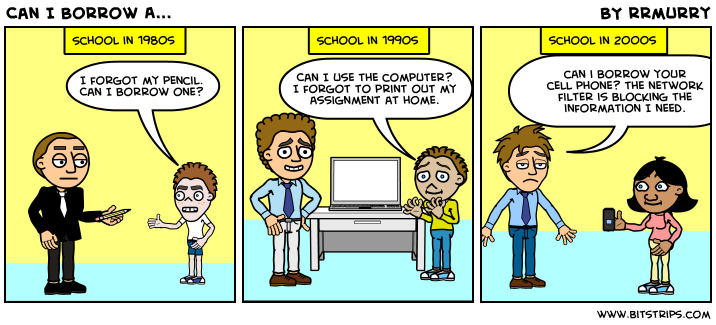
I ran across this comic strip today......

(click comic to view full size)

It made me ponder the paradox of technology in our schools.

My local school system is in the process of building a new middle school and remodeling the old high school and middle schools. The have a blog for the public and contractors to use.

Although the corporation office and the superintendent are making a great use of technology and the read-write web, the individual schools are a different story. The gatekeepers have blocked some of the most useful learning tools. Teachers and students have to find 'work-arounds' to access what they need. Substitute teachers have zero web access.

I hope that one day we all can look back on the above cartoon and laugh, "I remember when the useful parts of the internet used to be filtered."


It is hard to build the future when someone keeps locking the toolbox.

Link to original comic

Sunday, March 22, 2009

Tattoos and memories and dead skin on trial...

I attended a middle school swim meet a few days ago. I was scanning the crowd of students looking for my son. As I looked over the mob of early teens, I spotted this:


A small tattoo of a star on the shoulder of an eighth grade girl.

I was speechless....then angry....and then concerned.

How did a 14 year old child get a tattoo? An illegal act by a tattoo shop? A permission statement by the girls parents? An in-home tattoo party? A mother-daughter bonding experience? No matter how it happened, the result is the same. The 14 year old girl has a permanent tattoo.

I see the tattoo as a visible reminder of how many activities leave a permanent mark. Your online presence gets colored with indelible ink every time you log on to the internet.

Are you coloring your personal image with ink you may regret someday?
Think before you post...


Photo Credit

Saturday, March 7, 2009

Kindergarten Science - Plants! | Mrs. Poulin's Blog

Mrs. Poulin posted a video of elementary students experiencing science 'up close and personal'.

It's worth watching. Please take a look.

Kindergarten Science - Plants! | Mrs. Poulin's Blog

Posted using ShareThis

Friday, February 20, 2009

Upside Down and Backwards

I was describing my decision to change careers to an old friend a few days ago. He stated that my choices were 'upside down and backwards' from the normal way of doing things.

My activities with web 2.0 appear to be backwards as well.

  • I discovered Twitter by listening to a podcast.
  • I then learned about Plurk from Twitter.
  • Blogs, RSS, and Google Reader soon replaced my daily newspaper.
  • I became involved with live webcasting at EdTechtalk.
  • Finally...I started a blog.

Just when I was starting to get the hang of it all, I found out that in October of 2008, blogging was declared dead by Wired magazine.

Did I spend all of my time and energy learning to use a medium that was dead or dying? No, I don't think so. Blogging appears to be alive and well. Blogging is still quite healthy in the education community.

How do you learn new skills? Do you follow the unwritten syllabus of society, or are you an upside down and backwards learner?


photo credit

Friday, February 13, 2009

Testing the Power of the PLN

Today I will explore the potential power of my network. I am in need of some assistance.
I have the opportunity to receive credit for one of my teaching field experiences. I have to provide artifacts and references that prove that I have 'what it takes' to be an elementary teacher. I have plenty of artifacts from the classroom. I have several letters of reference from teachers and administrators. I need to prove that I am a life-long learner.

I need references that support my claim that I am actively engaged in online professional development. Any other comments about my learning, collaboration, and communication skills are also welcome. If we have met online and you feel that I am displaying the habits of a life-long-learner, please take a moment to express your thoughts.

Email and blog replies are welcome. Snail mail on school letterhead would be a big plus.
Drop me a note and I'll send you my mailing address if you are so inclined to send a hard copy.

Thank you in advance to my PLN. By helping me 'test out' of one of my requirements, you are accelerating my journey toward my teaching credentials.

Wednesday, February 4, 2009

They know where you are (if you tell them)

Google released a new add-on for Google Maps today.
It's named Latitude.
It installed quickly on my Windows Mobile device, and I had it up and running in under five minutes.

Here is Google's introduction video:


I've only had it running for a few minutes, but I can see exciting possibilities for this program.

Check it out. I'm going outside to play with my new toy :)

Sunday, February 1, 2009

Pick an Analogy...

Lately I've been reading about how web filtering in the school is doing a disservice to our children. Many people believe that blocking is a way to protect our children from all of the evils of the Internet. The 'walled garden' approach is favored by more than a few people.
Others believe that access that is completely free and unfiltered is the only way to teach digital citizenship. I believe the answer lies somewhere between the two extremes.

I have heard several creative ways of explaining why extreme filtering of the Internet in schools is not the best practice.
To paraphrase Wesley Fryer: We don't give a 16 year old the keys to a car and hope they can learn to drive on the public streets. Nobody would think of throwing a five year old into a swimming pool and hope that the child can swim. Why do people think it is appropriate to turn children loose on the Internet without teaching them the correct way to use it.

I agree with Mr. Fryer. Children need to be shown the correct and appropriate way to use the Internet.
I was listening to a broadcast on the EdTechTalk channel last week and ended up skyping in and discussing filtering with Doug Symington and a few others. Most of the people on the show and in the back channel discussion were in agreement about Internet filtering in schools. Teaching 21st century skills includes teaching how to use the Internet responsibly.

I read an article this morning in Edutopia that inspired me to write this blog. Kevin Honeycutt and Maria Knee are quoted in the article; and both offer some valuable insight on the topic. Please take a moment and read the article. The replies at the bottom of the page are quite enlightening.

I think that we should have some Internet filtering in schools, but I believe that the students and teachers should do the majority of the the filtering. We all have blacklists and whitelists of some kind on our personal computers. Why can't the entire school collaboratively build their own filter? I see the process of building a filter like this:
  • Known porn sites are blocked
  • Teachers and students are given access to the Internet
  • When inappropriate sites are discovered by students, a block request would be submitted to the IT department.
  • Teachers and administrators would have the power to place an immediate block on an inappropriate site.
  • A list (similar to a wiki) would be maintained to show who, when, and why a site was blocked.
  • Teachers would have the ability to override the filter.

Would this model work? Could we teach the students how to responsibly use the Internet? Could students build a filter that would be good for all grade levels in the school?
It would be an interesting experiment.

The bottom line:
Children leave school and go out into the real world. The Internet is unfiltered at home. Students need to know how to use this powerful tool responsibly.
We don't lock out the power saws in the shop class. We teach how to use the power tools safely and how to adjust the guards. We show our students how to create without doing damage to themselves or others.

We've been teaching responsibility in shop class for years. It's time to do the same in the computer lab.

Photo credit: swait-t on flicker. Link to original photo.