Today I will explore the potential power of my network. I am in need of some assistance.
I have the opportunity to receive credit for one of my teaching field experiences. I have to provide artifacts and references that prove that I have 'what it takes' to be an elementary teacher. I have plenty of artifacts from the classroom. I have several letters of reference from teachers and administrators. I need to prove that I am a life-long learner.
I need references that support my claim that I am actively engaged in online professional development. Any other comments about my learning, collaboration, and communication skills are also welcome. If we have met online and you feel that I am displaying the habits of a life-long-learner, please take a moment to express your thoughts.
Email and blog replies are welcome. Snail mail on school letterhead would be a big plus.
Drop me a note and I'll send you my mailing address if you are so inclined to send a hard copy.
Thank you in advance to my PLN. By helping me 'test out' of one of my requirements, you are accelerating my journey toward my teaching credentials.
Friday, February 13, 2009


Wednesday, February 4, 2009
They know where you are (if you tell them)
Google released a new add-on for Google Maps today.
It's named Latitude.
It installed quickly on my Windows Mobile device, and I had it up and running in under five minutes.
Here is Google's introduction video:
I've only had it running for a few minutes, but I can see exciting possibilities for this program.
Check it out. I'm going outside to play with my new toy :)
It's named Latitude.
It installed quickly on my Windows Mobile device, and I had it up and running in under five minutes.
Here is Google's introduction video:
I've only had it running for a few minutes, but I can see exciting possibilities for this program.
Check it out. I'm going outside to play with my new toy :)
Sunday, February 1, 2009
Pick an Analogy...
Lately I've been reading about how web filtering in the school is doing a disservice to our children. Many people believe that blocking is a way to protect our children from all of the evils of the Internet. The 'walled garden' approach is favored by more than a few people.
Others believe that access that is completely free and unfiltered is the only way to teach digital citizenship. I believe the answer lies somewhere between the two extremes.
I have heard several creative ways of explaining why extreme filtering of the Internet in schools is not the best practice.
To paraphrase Wesley Fryer: We don't give a 16 year old the keys to a car and hope they can learn to drive on the public streets. Nobody would think of throwing a five year old into a swimming pool and hope that the child can swim. Why do people think it is appropriate to turn children loose on the Internet without teaching them the correct way to use it.
I agree with Mr. Fryer. Children need to be shown the correct and appropriate way to use the Internet.
I was listening to a broadcast on the EdTechTalk channel last week and ended up skyping in and discussing filtering with Doug Symington and a few others. Most of the people on the show and in the back channel discussion were in agreement about Internet filtering in schools. Teaching 21st century skills includes teaching how to use the Internet responsibly.
I read an article this morning in Edutopia that inspired me to write this blog. Kevin Honeycutt and Maria Knee are quoted in the article; and both offer some valuable insight on the topic. Please take a moment and read the article. The replies at the bottom of the page are quite enlightening.
I think that we should have some Internet filtering in schools, but I believe that the students and teachers should do the majority of the the filtering. We all have blacklists and whitelists of some kind on our personal computers. Why can't the entire school collaboratively build their own filter? I see the process of building a filter like this:
Would this model work? Could we teach the students how to responsibly use the Internet? Could students build a filter that would be good for all grade levels in the school?
It would be an interesting experiment.
The bottom line:
Children leave school and go out into the real world. The Internet is unfiltered at home. Students need to know how to use this powerful tool responsibly.
We don't lock out the power saws in the shop class. We teach how to use the power tools safely and how to adjust the guards. We show our students how to create without doing damage to themselves or others.

We've been teaching responsibility in shop class for years. It's time to do the same in the computer lab.
Photo credit: swait-t on flicker. Link to original photo.
Others believe that access that is completely free and unfiltered is the only way to teach digital citizenship. I believe the answer lies somewhere between the two extremes.
I have heard several creative ways of explaining why extreme filtering of the Internet in schools is not the best practice.
To paraphrase Wesley Fryer: We don't give a 16 year old the keys to a car and hope they can learn to drive on the public streets. Nobody would think of throwing a five year old into a swimming pool and hope that the child can swim. Why do people think it is appropriate to turn children loose on the Internet without teaching them the correct way to use it.
I agree with Mr. Fryer. Children need to be shown the correct and appropriate way to use the Internet.
I was listening to a broadcast on the EdTechTalk channel last week and ended up skyping in and discussing filtering with Doug Symington and a few others. Most of the people on the show and in the back channel discussion were in agreement about Internet filtering in schools. Teaching 21st century skills includes teaching how to use the Internet responsibly.
I read an article this morning in Edutopia that inspired me to write this blog. Kevin Honeycutt and Maria Knee are quoted in the article; and both offer some valuable insight on the topic. Please take a moment and read the article. The replies at the bottom of the page are quite enlightening.
I think that we should have some Internet filtering in schools, but I believe that the students and teachers should do the majority of the the filtering. We all have blacklists and whitelists of some kind on our personal computers. Why can't the entire school collaboratively build their own filter? I see the process of building a filter like this:
- Known porn sites are blocked
- Teachers and students are given access to the Internet
- When inappropriate sites are discovered by students, a block request would be submitted to the IT department.
- Teachers and administrators would have the power to place an immediate block on an inappropriate site.
- A list (similar to a wiki) would be maintained to show who, when, and why a site was blocked.
- Teachers would have the ability to override the filter.
Would this model work? Could we teach the students how to responsibly use the Internet? Could students build a filter that would be good for all grade levels in the school?
It would be an interesting experiment.
The bottom line:
Children leave school and go out into the real world. The Internet is unfiltered at home. Students need to know how to use this powerful tool responsibly.
We don't lock out the power saws in the shop class. We teach how to use the power tools safely and how to adjust the guards. We show our students how to create without doing damage to themselves or others.

We've been teaching responsibility in shop class for years. It's time to do the same in the computer lab.
Photo credit: swait-t on flicker. Link to original photo.
Friday, January 30, 2009
Old team, new players, and current technology
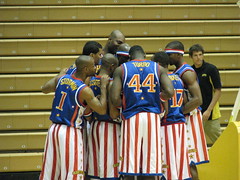
A few weeks ago I had the opportunity to purchase tickets to a Harlem Globetrotter game. The thought of attending the event brought back memories of watching Meadowlark Lemon and Curly Neal from the rug in front of our Quasar console television.
The event was held in a local college gymnasium. The sights and smells were just as I expected they would be. I watched the Globetrotters of today take the floor as the speakers played 'Sweet Georgia Brown"
As in years gone by, the 'trotters brought their opponents with them. I watched as the Washington Generals prepared to do battle with the mighty Globetrotters.
The Captain of the Globetrotters and the Coach of the Generals made a public wager before the game started. If the Generals won, the star Globetrotter would have to leave his team and play for the Generals. If the Globetrotters won, the Washington coach would have to dress in an embarrassing costume: a Tutu or a Hot Dog Suit.
The game progressed with the expected antics. Some new tricks were added, but many of the old favorites were played out on the court.

The part I found the most interesting was during half-time. The crowd was asked to vote on how the opposing coach should be publicly humiliated; either by tutu or silly suit. All the crowd had to do was vote.
It was enjoyable to be able to interact with the events on the court. Children everywhere were voting with their own phones or ones they begged from a parent. A good time was had by all.
The game progressed in the usual format. The generals lost and the crowd had fun.
How did the vote go? Not even close. Nobody wanted to see the coach in a tutu.

The event made me wonder how many creative ways there might be to use cell phones in education. A Google search for 'cell phone in education' returned over 40 million results.
How do you think we should use mobile phones in the education environment?
Saturday, January 24, 2009
You never know who may be watching.
I took a few minutes this morning to check my email, download some podcasts, and check my blog before I started on my homework. All was was going well until I clicked on the link to my statcounter page.
I was excited to see that there had been some new readers. I clicked the link that took me to the details page. This is what I found:

At first I was excited to see that a local person had found my blog. Then I read the name of the reader:
Indiana Department of Education
Wow! Somebody with a very local IP address that is connected with the Indiana DOE read my blog. Not just visited, but READ my blog. Their visit to my page lasted 38 minutes and 12 seconds; plenty of time to explore every post, comment and hyperlink.
What can be learned from this? There are several key points:
You never know who may be watching....
I was excited to see that there had been some new readers. I clicked the link that took me to the details page. This is what I found:

| VISITOR ANALYSIS | |
| Referrer | http://www.blogger.com/manage-followers.g?blogID=4931143214198385076 |
| Host Name | |
| IP Address | 165.138.239.15 |
| Country | United States |
| Region | Indiana |
| City | Demotte |
| ISP | Indiana Department Of Education |
| Returning Visits | 0 |
| Visit Length | 38 mins 12 secs |
Indiana Department of Education
Wow! Somebody with a very local IP address that is connected with the Indiana DOE read my blog. Not just visited, but READ my blog. Their visit to my page lasted 38 minutes and 12 seconds; plenty of time to explore every post, comment and hyperlink.
What can be learned from this? There are several key points:
- Your digital portfolio begins to form the instant you start posting content
- Anybody may be reading your material
- The things that you do today may affect your future in ways that you never imagined
- Your digital footprints are not made in the shifting sands of time, they are made in concrete
You never know who may be watching....
Monday, January 19, 2009
On the fence
IMG_0856
Originally uploaded by scottshelhart

This is my favorite one of the day.
Sunday, January 18, 2009
Learning from the children
Children can teach us great life lessons if we just open up our eyes and watch.
What lessons can be seen in this clip?
What do you see in this clip?
What lessons can be seen in this clip?
- Some things are worth doing more than once, just for the pure enjoyment.
- It's not always about who wins.
- Fun is where you find it.
- Sometimes the journey is more important than the destination.
What do you see in this clip?
Subscribe to:
Posts (Atom)


 Posts
Posts


